
Do I Have Enough to Retire
Do I Have Enough to Retire
A practical framework for turning savings into a retirement income plan
You may have enough to retire when your assets and dependable income can support your spending over a realistic lifetime, with room for taxes, inflation and setbacks. A savings balance alone cannot establish that. The answer comes from a year-by-year plan and the adjustments you can make when life changes.
The most useful starting question is how much your investments must provide after Social Security, pensions and other income. That amount connects your lifestyle to your savings. A household with a smaller portfolio and modest expenses may be better prepared than one with more wealth and substantially higher spending.
Start with the life you want to fund
Review the last 12 months of bank and credit-card statements. Separate essential expenses such as housing, food, utilities, insurance and healthcare from flexible spending such as travel, entertainment and gifts. Include property taxes, home maintenance, vehicle replacement and family support. Spread irregular bills across the year, while recording major one-time purchases separately.
Retirement may remove commuting and payroll contributions, but it can add travel, private health insurance and more time for expensive hobbies. Build a budget for the early active years and another for later years when care needs may rise. For homeowners in costly markets, mortgage-free living still includes taxes, insurance, repairs and possibly HOA dues.

Figure 1 Hypothetical annual cash flow. The $96,000 need includes an estimated income-tax allowance; income sources are shown gross. All benefits are assumed to have started.
Calculate your first income gap
Suppose a household needs $8,000 per month, including an estimated allowance for income taxes. Social Security and a pension provide $5,000 per month before tax. Savings must supply $3,000 per month, or $36,000 per year. Use consistent tax treatment on both sides and refine the estimate with an actual tax projection.
If you retire before these benefits begin, the gap will be larger for the intervening years. Calculate that bridge separately. Then gather account balances, debts, benefit estimates, insurance details and a target retirement date. These inputs make the next calculation meaningful.
Translate the income gap into a savings target
A withdrawal rate is the amount taken from investments in the first year divided by the starting portfolio. A $36,000 withdrawal from $1 million is 3.6%. It is a useful diagnostic, but it does not prove that the portfolio will last. Retirement length, asset allocation, investment expenses, taxes and spending flexibility all affect the result.
Use a range rather than a magic number
For a rough screen, divide the annual portfolio-funded gap by an assumed starting withdrawal rate. The same $36,000 annual gap produces the targets below. These figures are arithmetic illustrations, not recommended rates. They assume the portfolio funds that recurring gap; separately identified near-term costs or reserves must also be funded without counting the same dollars twice.
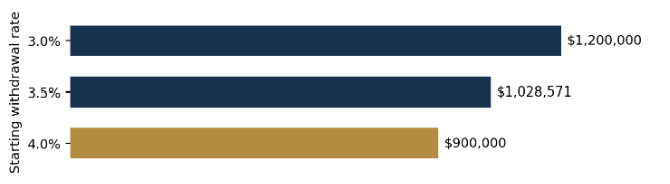
Figure 2 Illustrative portfolio targets for a $36,000 first-year gap. Target equals annual gap divided by starting rate. Figures are rounded; no success probability is implied.
The familiar 4% framework generally refers to withdrawing 4% of the initial portfolio in year one and then adjusting the dollar withdrawal for inflation. Taking 4% of the changing balance every year is a different strategy: income can fall after losses. Neither approach guarantees that your desired lifestyle will remain affordable.
Morningstar’s 2025 research, discussed in its 2026 withdrawal-rate article, estimated a 3.9% starting rate for consistent inflation-adjusted spending over 30 years with a modeled 90% probability of funds remaining. That is a result under the study’s assumptions, not a promise or a rate suitable for every retiree. Longer retirements and different portfolios require their own analysis. [1]
Count assets that can actually fund spending
List taxable investments, traditional retirement accounts, Roth accounts and cash separately. A dollar in a traditional IRA usually does not provide the same spendable amount as a dollar from a qualified Roth withdrawal. Project taxes across the household rather than applying one flat rate to every account.
Home equity is part of wealth, but it is not automatically retirement income. Include it only with an explicit plan such as selling, downsizing or borrowing, and account for replacement housing and transaction or financing costs. Likewise, use rental income after vacancy, repairs, management, debt service and taxes. A rental property value and its rent are not two independent pools of spendable wealth.
A retirement at 55 can require substantially more years of funding than one at 70. Model the lifetime of the household, including a surviving spouse, and test a longer life than you expect. The resulting range is more useful than a single savings milestone.
Test what happens when markets disappoint
Investment returns do not arrive evenly. Losses early in retirement can be particularly damaging because withdrawals remove shares that would otherwise participate in a recovery. This is sequence-of-returns risk. An average return hides the timing that matters to a household paying bills every month.
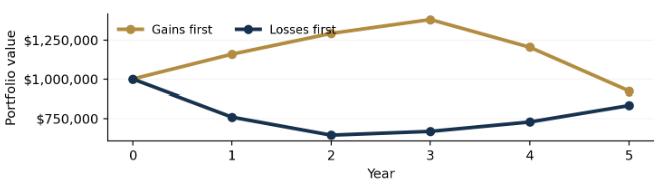
Figure 3 Hypothetical $1 million portfolio with $40,000 withdrawn at each year-end. Returns are −20%, −10%, +10%, +15%, +20%, or the reverse. No taxes, fees or inflation; not a forecast.
Both paths use identical returns in a different order. After five years, losses first leaves approximately $834,392; gains first leaves $924,048. Without withdrawals, the ending values would be identical. With withdrawals, the difference is about $89,656. This example shows why a strong long-term average cannot by itself establish retirement readiness.
Give each part of the portfolio a purpose
Match near-term spending needs with accessible assets that fit your risk tolerance. Cash can help avoid selling volatile investments at an unfavorable time, while high-quality bonds may help fund scheduled needs. Stocks can contribute long-term growth, but their value can fall sharply. Bonds also carry risks, including interest-rate and credit risk. Diversification can reduce concentration; it cannot eliminate losses.
The right reserve depends on your income gap, job flexibility, spending priorities and other resources. Holding too much cash can weaken purchasing power over time. Holding too little can force difficult sales. Decide how reserves will be replenished and how the portfolio will be rebalanced before a downturn occurs.
Stress test decisions you can act on
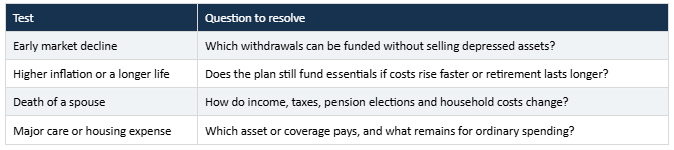
If a scenario fails, quantify a response: reduce discretionary spending, work longer, save more, change housing or reconsider the retirement date. Simulation tools can help compare choices, but their success percentages depend on assumptions. Ask what “success” means, what costs are included and which events the model omits. Review the plan annually and after major life changes.
Plan for inflation taxes and healthcare
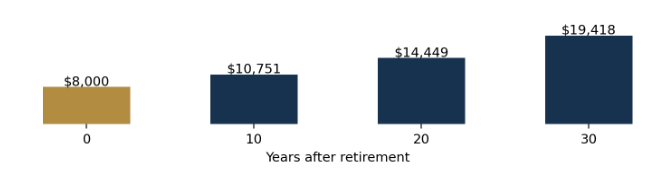
A retirement plan must fund future prices. At an assumed 3% annual inflation rate, a lifestyle costing $8,000 per month today would cost about $14,449 in 20 years and $19,418 in 30 years. This is a mathematical illustration, not an inflation forecast. Individual costs and income sources can increase at different rates.
Coordinate benefits with the years before they start
For people born in 1960 or later, Social Security full retirement age is 67. Waiting until 70 provides 124% of the full-retirement-age monthly benefit, before considering cost-of-living adjustments; delayed credits stop at 70. [2] Waiting can improve later income, but requires other resources in the meantime. Compare health, longevity, spouse and survivor needs, taxes and the cost of funding that bridge.
Plan health coverage before Medicare eligibility and then budget Medicare premiums, other coverage, prescriptions and out-of-pocket expenses. Medicare generally does not pay for ongoing custodial long-term care, such as assistance with bathing or dressing. Certain qualifying skilled care is different. [3] Decide whether care would be funded from savings, insurance, family resources or available public programs, and test the consequences for a spouse.
Choose withdrawals with taxes and access in mind
Account order matters because withdrawals and conversions can affect taxable income and other income-related costs. Compare annual projections for taxable accounts, traditional accounts and Roth assets, including required distributions when applicable. A Roth conversion creates current taxable income; its value depends on current and future tax circumstances and the ability to pay the tax.
Access also matters for early retirees. Taxable withdrawals before age 59½ can trigger a 10% additional federal tax unless an exception applies. The separation-from-service exception beginning in the year you turn 55 can apply to qualifying employer-plan distributions, but not IRA distributions. [4] Confirm eligibility and plan rules before moving funds; ordinary income tax may still apply.
Evaluate income guarantees alongside their costs
An annuity may help cover an essential income gap, but compare payout terms, inflation exposure, liquidity, fees, surrender charges and survivor benefits. Guarantees depend on the insurer’s financial strength and claims-paying ability. [5] Money committed to a contract is no longer fully available for other goals. Evaluate the complete household plan before choosing a product.
Decide what enough means for your household
You are closer to retirement readiness when essential spending is funded, discretionary spending can adjust, and the plan has credible responses to bad markets, care needs and a long life. A large balance with an unexplained income gap calls for more work. A modest balance with dependable income and flexible costs may support a sound plan. Neither conclusion should be based on the balance alone.
Revisit the household example
Our hypothetical household needs $96,000 per year, including its tax allowance, and receives $60,000 in gross Social Security and pension income. A $1 million investment portfolio must initially provide $36,000, a 3.6% starting withdrawal rate. That makes the household a candidate for further analysis; it does not establish that retirement is affordable.
If spending rises by $1,000 per month, the annual gap becomes $48,000 and the starting rate rises to 4.8%. If the household instead lowers recurring spending by $500 per month from the original budget, the gap becomes $30,000 and the starting rate falls to 3.0%. Each change must be tested over time, including inflation, tax effects and benefits that have not yet started.
Prepare a decision you can review
First, confirm your budget and actual Social Security and pension estimates. Second, project each year’s income gap, including the years before benefits begin and the years after a spouse dies. Third, identify accessible assets, debt payments, planned purchases and a source for unexpected costs. Finally, compare retiring now with working longer or spending less, using the same assumptions in every scenario.
Ask an appropriately qualified financial professional to show you the assumptions, account-level tax effects, investment expenses and changes needed under adverse conditions. Ask how the professional is compensated and whether a recommended product restricts access to your money. Write down the spending adjustment or other action you would take if the plan falls behind.
The practical answer to “Do I have enough to retire?” is a documented plan that supports your chosen lifestyle with an acceptable margin for uncertainty. Your next step is to calculate your personal income gap and test it against the resources and choices you actually have.
Sources and important context
[1] Morningstar, What’s a Safe Retirement Withdrawal Rate for 2026, discussing 2025 research. morningstar.com/retirement/whats-safe-retirement-withdrawal-rate-2026
[2] Social Security Administration, Delayed Retirement for Those Born in 1960 or Later. ssa.gov/benefits/retirement/planner/1960-delay.html
[3] Medicare, Long Term Care Coverage. medicare.gov/coverage/long-term-care
[4] IRS, Retirement Topics — Exceptions to Tax on Early Distributions. irs.gov/retirement-plans/plan-participant-employee/retirement-topics-exceptions-to-tax-on-early-distributions
[5] SEC Investor.gov, Annuities. investor.gov/introduction-investing/investing-basics/investment-products/annuities
Sources checked October 21, 2026. Original educational article; not authored, reviewed or endorsed by Morgan Stanley. No firm affiliation or professional credential is claimed. Hypothetical examples are not forecasts. This is general education, not individualized investment, tax or legal advice. Consult qualified professionals about your circumstances.
