
How Can Insurance Protect My Family
How Can Insurance Protect My Family
By Thomas Nguyen | True North Financial Group
A practical guide for families with children and households approaching retirement
Insurance can help your family keep paying essential bills when a death, illness, disability, care need or liability claim changes your finances. It transfers specified financial risks to an insurer in return for premiums, subject to the policy’s terms. The strongest protection plan starts with the losses your household could not comfortably absorb and matches coverage to those needs.
My starting point is the life your family needs to maintain. Could a surviving spouse stay in the home? Who would pay for childcare if a parent could no longer provide it? Would a long illness force you to spend retirement savings? Those questions help determine the amount, duration and type of coverage to review before choosing a product.
Give each policy a clear purpose
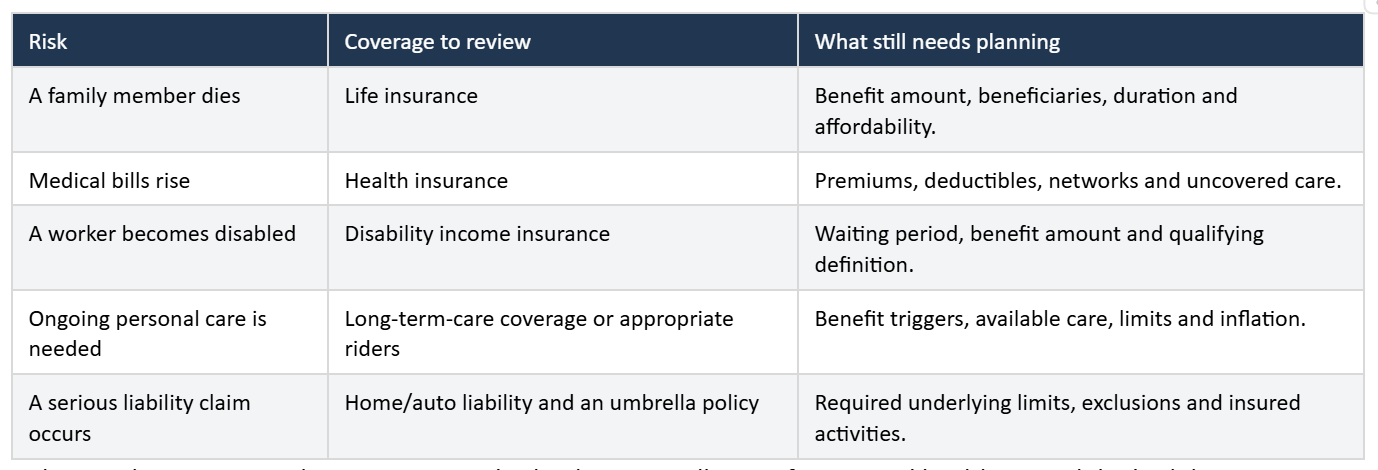
These policies are complementary. A medical policy generally pays for covered healthcare, while disability insurance replaces some qualifying lost income. Life insurance generally pays after the insured person dies. A living-benefit rider may address particular illnesses, but it does not automatically replace comprehensive health, disability or long-term-care insurance. Read eligibility and benefit definitions separately. [1, 4–7]
Match protection to your stage of life
Families raising children may need substantial temporary life coverage, disability protection and funds for childcare or education. As retirement approaches, needs may shift toward a surviving spouse’s income, care costs and liabilities that could affect accumulated assets. A paid-off mortgage or financially independent children may reduce some needs; dependent relatives or lifelong support commitments may extend others.
Keep an emergency reserve alongside insurance. Deductibles, waiting periods and excluded expenses can create costs before or outside a claim. Coverage should be affordable enough to maintain through difficult years. A smaller policy that stays in force can serve a family better than an ambitious design that becomes unaffordable.
Estimate how much life insurance your family needs
Life insurance should address the financial effect of a particular person’s death. Estimate the survivor’s needs, subtract the resources genuinely available for those needs, and review how long the shortfall lasts. A salary multiple is only a rough screen. It can miss unpaid caregiving, debt choices, existing coverage and the survivor’s own income.
A hypothetical couple with two children
Assume a couple has children ages 6 and 9 and a $600,000 mortgage. After paying off that mortgage, the surviving household is assumed to need $50,000 of additional annual support for 12 years, beyond the survivor’s own earnings and other dependable income. This support budget excludes the mortgage payments and the separate care and education amounts listed below to avoid double counting.
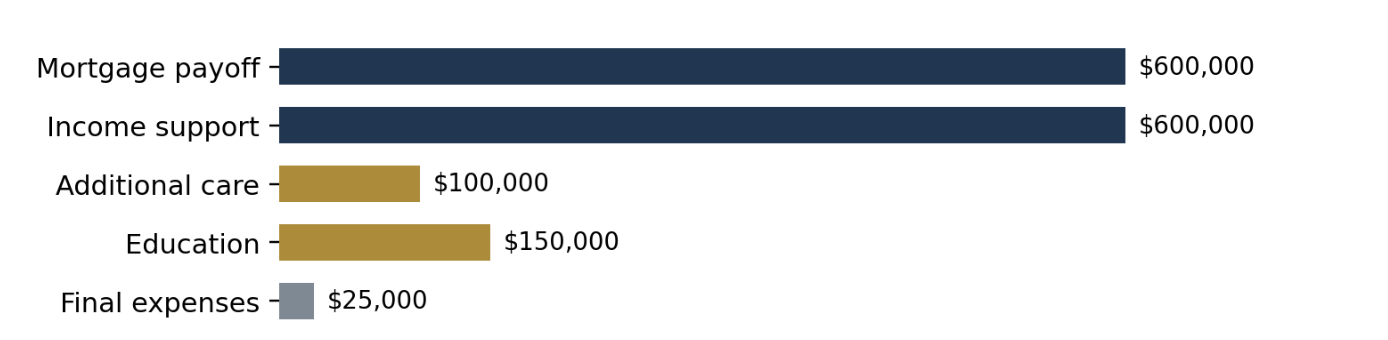
Figure 1 Hypothetical needs: $600,000 mortgage + $600,000 income support ($50,000 × 12 years) + $100,000 additional care + $150,000 education + $25,000 final expenses = $1,475,000. These are planning inputs, not cost forecasts.
Suppose $125,000 of accessible savings is specifically available for survivor needs and an existing $250,000 life policy is expected to remain in force. Subtracting $375,000 from $1,475,000 gives an initial additional coverage estimate of $1.1 million. If the $250,000 is employer coverage that will not remain available, the corresponding estimate becomes $1.35 million. Confirm portability, conversion rights and deadlines before relying on a workplace benefit.
This is a simple undiscounted estimate. It assumes no investment growth or inflation and does not fully model taxes, future spending changes or survivor benefits. An individual analysis should project actual cash flows, update the education and care assumptions and verify any Social Security survivor eligibility. Paying off the mortgage is a choice to evaluate, not a rule for every family.
Value both paid work and unpaid care
Repeat the calculation for each spouse. A parent who provides childcare, transportation or household management may need coverage even without a paycheck. Estimate the replacement cost of those services and any work hours the survivor would lose. Do not count the same savings twice as though it were independently available for two simultaneous needs.
Separate resources you can spend from those reserved for retirement or other obligations. Home equity does not automatically pay monthly bills unless a sale or borrowing plan is workable. A retirement account may involve taxes when accessed. Review debt payoff, income replacement and education together so one goal does not silently use the money intended for another.
Choose a duration you can sustain
A family may need a larger benefit while children are dependent and a smaller amount later. Compare an appropriate term length, any conversion options and a possible mix of policies. Underwriting, age, health, tobacco use, benefit amount and policy design affect available pricing. Obtain real quotes rather than assuming a particular premium.
Compare term whole life IUL and VUL
The first decision is how much death-benefit protection you need and for how long. Then compare the policy’s cost, guarantees and monitoring requirements. Cash value can be useful for some long-term needs, but it should not distract from adequate coverage and a premium budget you can maintain.
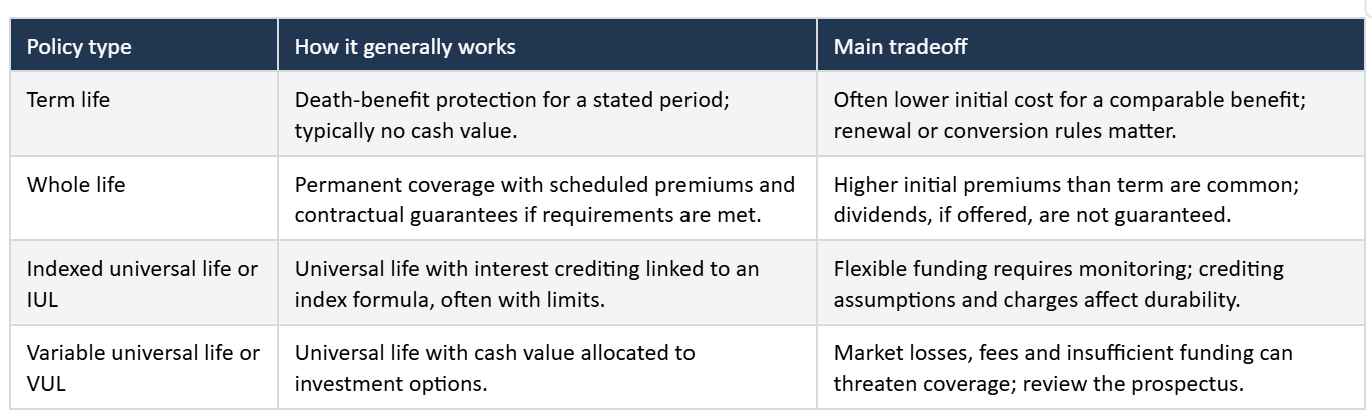
Term insurance often fits a temporary need such as dependent children or a mortgage. Permanent coverage may fit a lasting need, such as support for a dependent who will need help throughout life or a planned legacy, if premiums remain affordable. “Permanent” describes the intended design, not immunity from lapse. Policy conditions still apply. [1, 2]
Understand what an IUL floor actually protects
An IUL generally does not place your cash value directly in the referenced index. Interest depends on the policy’s formula, and current caps or participation rates may change within contractual limits. A 0% index-credit floor does not stop policy charges from reducing cash value. Lower credits or higher insurance costs can require additional funding to maintain coverage. [2]

Figure 2 Simplified IUL arithmetic: $20,000 starting cash value + $0 index interest − $2,000 assumed annual charges = $18,000. No premiums, withdrawals or loans; actual charge timing and guarantees vary. Not a quote or projection.
Read guaranteed and illustrated values separately
For whole life, compare guaranteed values separately from nonguaranteed dividends. For IUL, request lower-crediting scenarios and the funding needed under adverse assumptions. For VUL, understand investment risk, policy fees and any conditional death-benefit guarantees. Request in-force illustrations for existing policies rather than relying on the original sales illustration. [2, 3]
Policy loans accrue interest and can reduce available value or death proceeds. A loan can also contribute to lapse, and termination with a loan outstanding can create taxable income. Modified endowment contracts have different tax treatment. Do not treat policy loans as automatically tax-free retirement income or confuse cash surrender value with the death benefit. [3]
Protect income care needs and family assets
Life insurance addresses a death-related loss. Families also need a plan for events during life. Start by reviewing existing employer benefits and household reserves, then identify what remains uncovered. The waiting period, benefit definition and exclusions can matter as much as the advertised coverage amount.
Health insurance and disability protect different bills
For health coverage, compare provider networks, prescriptions, deductibles, coinsurance and the out-of-pocket maximum. The maximum generally applies to covered in-network care and does not include premiums, noncovered services or all out-of-network costs. Budget those separately instead of assuming the maximum is your entire annual medical expense. [4]
Disability income insurance can replace part of lost earnings when a covered condition prevents qualifying work. Compare an own-occupation definition with an any-occupation definition, the elimination period, benefit duration, offsets and exclusions. Ask whether benefits would be taxable given who pays the premium and how it is paid. Do not assume a quoted percentage of salary equals spendable income. [5]

Figure 3 Hypothetical monthly budget of $6,000 with $1,000 other spendable income. Assume a three-month elimination period, then a $4,000 spendable disability benefit from month four, with the claim qualifying throughout. Unfunded gap: $5,000 monthly first, then $1,000. Not policy terms or a claim guarantee.
In this illustration, reserves need to cover $15,000 over the first three months. The continuing $1,000 gap requires another $9,000 over months four through twelve if nothing else changes. Actual benefits may start later or differ after tax and offsets. Verify how the waiting period is counted and when payments actually arrive.
Plan for long-term care before a crisis
Medicare generally does not pay for ongoing custodial care, such as help with bathing or dressing; qualifying skilled care is different. [6] Compare self-funding, standalone long-term-care insurance and appropriate linked-benefit coverage. Review claim triggers, elimination periods, covered settings, benefit pools, inflation options and premium sustainability. A chronic-illness or accelerated-death-benefit rider may reduce the death benefit and may not provide the same coverage as long-term-care insurance.
Use liability coverage to protect accumulated assets
Home and auto liability insurance are the starting point. A personal umbrella may add covered liability and defense protection above underlying policies or for certain additional claims. It does not insure every lawsuit or replace coverage for damage to your own property. [7] Review required underlying limits and exclusions with a property-and-casualty professional, including rentals, business activities, household drivers and recreational vehicles where relevant.
Build protection your family can maintain and use
A protection plan should remain useful as your family changes. Review it after a birth, marriage, divorce, home purchase, job change, diagnosis or retirement decision, and at least periodically between major events. Update the coverage need before assuming an existing benefit is still enough or that an older policy should be replaced.
Make the next review practical
List each policy’s insured person, owner, beneficiary, benefit, premium, renewal date and important exclusions. Add employer coverage and note whether it can continue after leaving the job. Compare household income and reserves with waiting periods, deductibles and likely claim gaps. For cash-value policies, request current values, loans and an in-force illustration showing whether planned funding remains adequate.
Prioritize affordable protection for the largest gaps. Compare quotes using the same benefit, duration and assumptions. Ask how the professional is compensated, what is guaranteed and what could change. Do not cancel existing coverage until any replacement has been issued, accepted and verified as in force; compare new underwriting, exclusions, charges and any restarted contestability provisions. [1]
Review primary and contingent beneficiaries and coordinate them with your estate documents. For minor children or a person with special needs, ask an estate attorney about an appropriate arrangement rather than assuming a direct designation will accomplish your intent. Keep a secure policy inventory and tell a trusted person how to locate it and contact insurers when a claim is needed.
A message from Thomas
At True North Financial Group, I encourage families to begin with the responsibilities they want to protect. Bring your benefit statements, policies and monthly budget to a conversation about life and health insurance needs. We can identify gaps and questions for your tax, legal and other qualified professionals. For VUL or other securities, involve an appropriately registered professional. The goal is coverage you understand and can sustain.
Sources and important information
[1] NAIC, Life Insurance consumer guide. https://content.naic.org/consumer/life-insurance.htm
[2] NAIC, Life Insurance product overview. https://content.naic.org/insurance-topics/life-insurance
[3] SEC Investor.gov, Variable Life Insurance. https://www.investor.gov/introduction-investing/investing-basics/investment-products/variable-life
[4] HealthCare.gov, Out-of-Pocket Maximum. https://www.healthcare.gov/glossary/out-of-pocket-maximum-limit/
[5] NAIC, Simplifying the Complications of Disability Insurance. https://content.naic.org/article/consumer_insight_simplifying_complications_disability_insurance.htm
[6] Medicare, Long-Term Care. https://www.medicare.gov/coverage/long-term-care
[7] NAIC, What’s an Umbrella Policy. https://content.naic.org/article/whats-umbrella-policy
[8] IRS, Life Insurance and Disability Insurance Proceeds. https://www.irs.gov/faqs/interest-dividends-other-types-of-income/life-insurance-disability-insurance-proceeds/life-insurance-disability-insurance-proceeds
Life insurance death proceeds are generally excluded from a beneficiary’s federal gross income, but interest and certain transactions can be taxable. [8] Sources checked October 21, 2026. General education, not individualized investment, tax or legal advice. Examples are hypothetical, not quotes, forecasts or coverage recommendations. Claims and guarantees depend on policy terms, eligibility and the insurer’s claims-paying ability. Prepared for Thomas Nguyen and True North Financial Group; no Morgan Stanley affiliation, authorship or endorsement is claimed.
